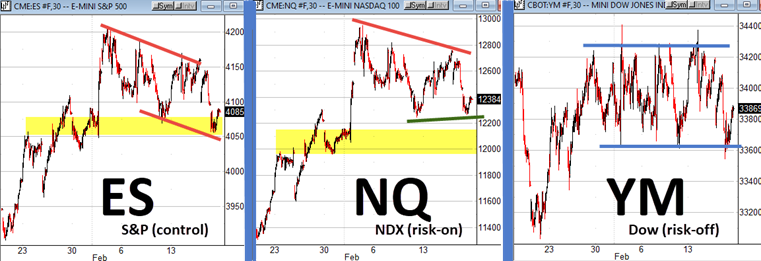
BIGGER PICTURE [No video until Tue's pre-open Planner] Last week saw the story change, two weeks after the trend's direction had already changed. Among several other influences, the rally that began in October has been anticipating the end was in sight for 25 bps rate hikes, amid growing certainty for an oncoming recession. But last week heard from two Fed speakers (Mester, Bullard) who favor more hikes, if not also at a higher 50 bps step. This "perfect storm" started with Thu's hot pre-open PPI, whose headline reaction rejected a budding breakout of downtrending resistance that instead reversed down into the weekend: So, is the 2-week old reversing downtrend validated by undermining the rally's chief influence, or is the downtrend now discounting that influence? Mester and Bullard are non-voting FOMC members this year. With their views now disseminated, we can anticipate softer prices ahead of their scheduled appearances. We can also monitor for exploiting a temporary blip-down in reaction to their headline, likely to stretch the rubber band for a snap back up. But these are temporary effects that don't necessarily guide the longer-term trend. As the chart depicts, price action has two primary characteristics to consider. I describe them, and then describe other influential clues below them. (The first of the other influences is the least appreciated, and I think a near-term recovery's best chance.) First, the two chart characteristics: 1. Spindle. Each session of the channel overlaps 4136 at some point intraday. Every session but two -- the Feb 2 high and Feb 10's prior low. In both instances, the attraction back to 4136 snapped price back into the channel. And now Friday has avoided overlapping 4136 again. Snapping back up into the channel would be credible coming out of the weekend, and that would be credible for extending higher. Otherwise, another detached session that extends even deeper is possible, while still maintaining the channel's downtrending support. Meanwhile, the channel's downtrending resistance now coincides at 4136 to double the impact of its recovery. 2. Lower prior highs. The last upleg into the channel contains peaks at 4053 and 4074 that serve as support when tested from above. Which they did on Friday. Reversing up higher than did Friday's bounces during the next session would be credible for extending to fully retrace Thursday's "perfect storm," if not also ending the channel with a new upleg. Extending any deeper instead would have limited time and space before becoming a deeper downleg at a steeper slope. 3. Perfect storm. The perfect storm's influence may seem outsized, but it has equaled the likely upleg that the channel's breakout would have targeted. The channel's extra downleg changes only the timing and path higher if the breakout intends to retry -- but it's not required to retry. Mixed signals aren't necessarily contradictions. They're the usual variety of disparate catalysts that all vie to be satisfied, which the market eventually does. Digressing for a moment, here's an unrelated albeit humorous example I noticed in this weekend's Barron's of two Crytpo stories juxtaposed inadvertently(?): A. Expiration exacerbation. Back to current influences, beginning with the least appreciated in my experience. It comes from the deafening cacophony of bearish forecasts that gained immediate high-profile as one Fed speaker, then another, imploded the rally's justification with their renewed inflation fears. Fair enough. But the forecasts pole vaulted over simple caution about an extended pullback, and instead confidently pronounced the start of a new protracted decline. Perhaps. These sudden paradigm shifts aren't unusual, but they are often proved wrong when their price action inputs form during unusual timing windows. E.G. expiration, 3-day weekend illiquidity. And in this instance, seasonal events did exacerbate volatility ahead of Friday, and overnight, leveraging the Fed speaker headlines' impact. That's not organic sponsorship, so their influence tends to be temporary. The mechanics of expiration cause a ricochet as position-jockeying essentially executes a 180-degree turn -- on a tight deadline, among a concentration of heavily-funded market participants. And suddenly their influence ends as the deadline arrives. We'll soon see whether this almost entirely anecdotal observation plays out again. B. Unfinished business above. Two separate setups that formed at Feb 2's 4208 high suggest the channel is only a temporary correction. First, simultaneously overbought 1-minute and 3-minute RSIs require its retest. Second, the same session confirmed Feb 1's breakout from a multi-session range, which requires at least an eventual higher close. C. Big money risk comparisons. The top-3 depictions of big money influence (shown below) are the 500-component S&P 500, the 100-component NDX, and the 30-component Dow Industrials. Compared to the S&P control group, the NDX's risk-on destination held up well into the weekend. Meanwhile, the risk-off Dow has been range bound but did produce a fresh low Friday. The comparison is not a timing tool, but usually resolves as suggested by its context -- that big money is accumulating the channel's price pullback. Alternatively, a deeper pullback or outright decline may be underway. Notwithstanding the unfinished business created at 4208, the earliest candidate for a high was identified last year above 4200 -- now met. And while not a timing tool, there's also rising optimism among so-called individual investors, which can be bearish from a contrarian perspective. Rising interest rates have helped to fuel the downtrending channel, and now sit on the precipice of breaking up sharply if falling bonds aren't contained here. And the Euro has been sitting on its own precipice, with potential for the USD to break sharply higher, too. In other words, the usual struggle among disparate sponsorship to exert their influence. Each of these influences can be as valid as the other, and the market can discount them all, in an order that enables a concerted resolution to develop. Currently, this ordering is depicted by the 2-week old downtrending channel. And either the market has ordered the discounts to end with more bullish influences positioned to retake control, or else another bear market rally is about to announce it has ended. More hawkish Fed speakers or other inflation-increase econ reports would be welcome to give us a price reaction that we can assess for the decline gaining traction, or being done. Levels : UP: 4108, 4133, 4188, 4231... DOWN: 4036, 4001, 3968. TUE A.M. BIAS STRATEGY: A 60-90 minute bias will trigger at 10:15 ET if:Professional Pre-Open Trading Plan - 8:40 AM
Edit

Visualize. Identify. Do It.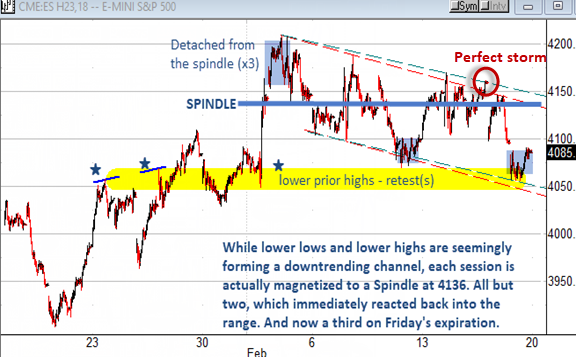

Tomorrow's Day Trading Plan - 4:56 PM
Edit
BIAS-UP will trigger above 4095, targeting 4108.
BIAS-DOWN will trigger under 4078, targeting 4064.
NO-BIAS if still between both signals.